How to support local journalism

That title probably deserves a question mark at the end, because I don’t pretend to have a definitive answer. Supporting local journalism is something I really want to do. It’s important to me. It’s something I’ve done almost my entire life, either by consuming it, paying for it, donating toward it, or, most often, directly contributing my byline to it.
In today’s media landscape, however, supporting local journalism proves formidable, like trying to strike a constantly moving target with a slowly deflating ball.
I think about this question a lot for obvious reasons, but also because of two recent events. First, some former colleagues of mine at the Missoula Independent (RIP) recently announced the launch of a hopeful replacement news source. I immediately signed up for The Pulp, took the reader survey and donated financially. I look forward to supporting them however possible in the future. Second, I begrudgingly downgraded my subscription to my current hometown daily, the Arizona Republic. It had to be done, it was the right thing to do and yet I feel badly about it.
Brief backstory: I’ve paid for home delivery of the printed paper since returning to The Valley four years ago. The Republic, battered as much if not more than any other daily in the nation (see print circulation chart below), still produces some fantastic work by talented journalists. Is it a shell of its former self? Of course. Have I had complaints? Many. Enough to cancel? No. Local journalism is too important.
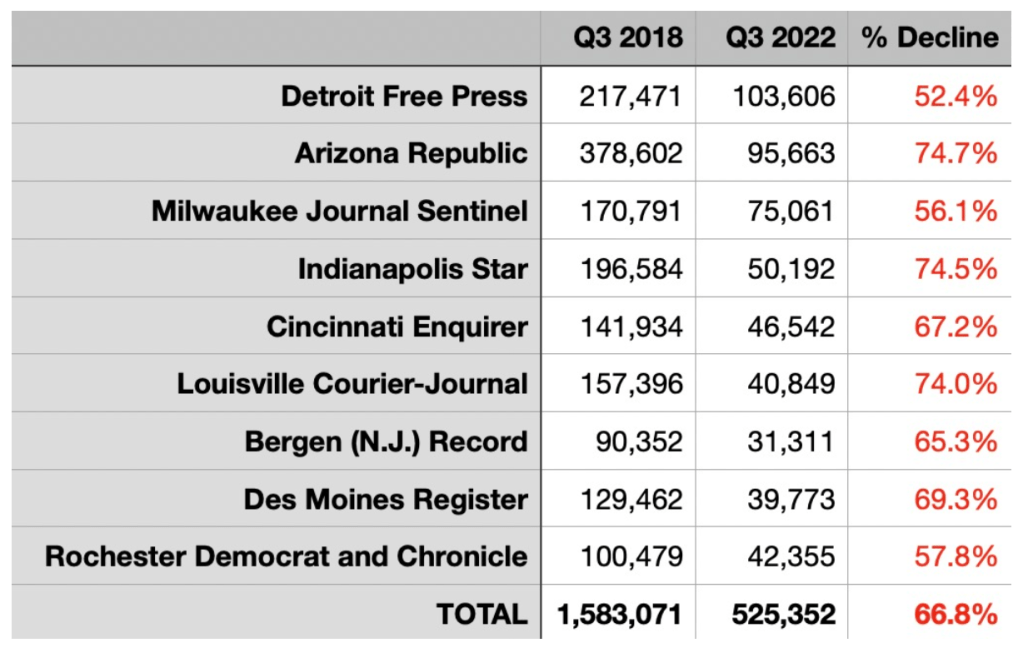
Then a recent investigative piece left me dumbfounded. It was an important story, deeply researched, shedding much-needed light on a shady business in my area. Reading the story in the printed paper, I found it well written, but couldn’t help but notice a disappointing number of typos, sentence-level errors and missing words (no biggie; not the point of this post).
As I continued, however, I found key players in the story never fully identified and/or introduced as if the reader already knew who they were. I thought I was losing my mind—or maybe misreading where each of the multiple jumps throughout the A section landed—until I checked the online version and discovered that entire chunks of the story, hundreds and hundreds and hundreds of words, had been sloppily cut from the print edition. In other words, the reporting was there, but at some point in the editing process, someone decided that dozens of paragraphs with foundational information were not important enough to reach print readers.
Here’s the thing: I’ve seen this before (on much smaller scales). I’ve been the one who’s cut the wrong graph or had my first reference of a source edited out. The Republic feature bummed me out for exactly that reason—I understand the amount of work that goes into this type of reporting, and, just as noteworthy, the number of factors beyond the newsroom that most likely impacted the final product. It stinks.
But it shouldn’t happen with an in-depth investigative piece on the cover of your biggest print edition of the week. For the first time in maybe forever, I wrote to the section editor. Not to bitch and moan; I tried very hard to make it clear that, as frustrating as this reading experience had been, the blame was probably best directed to the boardroom, not the newsroom. Mistakes like this happen when managers decimate copy desks, eliminate editors and gut staff. My question to the section editor:
How can I best support the Republic — and specifically the newsroom — moving forward? I should not get this mad reading an otherwise solid story and would prefer to be part of a long-term solution to Arizona journalism rather than part of the problem, such as yet another reader dropping their subscription. Any suggestions would be welcome.
I was sincerely more interested in the answer to the question than an explanation to what went wrong. I got both in a very gracious response. The explanation was apologetic and expected, noting the limits of print editions, oversights on deadline, etc. The answer to my main question boiled down to “don’t give up on us.” The editor added “the fullest version of every article” will always exist online.
I read this as permission to cancel the print side of my subscription. In other words, if I want to read the Republic’s best work, and continue to support it, simply stick to online. So I will, even if this means I give them less money.
This hardly feels like the right answer, yet here we are.
Which brings me back to the original point of this post about how to best support local journalism.
Here’s what I’m doing: While the Republic figures itself out, I will subscribe online and continue to give as much if not more money to alternative outlets in hopes that they continue to nip at the somewhat bigger guy’s heels. In Arizona, that means one-time annual donations to The Phoenix New Times, the erstwhile free weekly, and the Arizona Center for Investigative Journalism, a fledgling nonprofit group that unveils a few in-depth stories a year. The local NPR station also gets a pledge.
My Montana roots remain strong, so I will also continue to support my friends and former colleagues there. In addition to The Pulp and a subscription to the good folks at Montana Quarterly, this primarily means doing whatever I can for the state’s award-winning independent news source, The Montana Free Press, where I’m a major donor and interim chair of the board of directors.
If you combine all of the above with national subscriptions, it becomes a substantial investment. And it still feels like not nearly enough.
 SkylarBrowning.com
Leave a comment